
From Business Owner to Financially Informed Leader: CITY Diamond Founder Shares Her Accounting Learning Journey at CEO Master Club

IENG Chanthea says practical accounting knowledge is giving her greater confidence to lead employees, strengthen financial control, and move beyond managing every financial detail herself.
PHNOM PENH, Cambodia — For many entrepreneurs, building a successful company requires courage, persistence, market knowledge, and an ability to make difficult decisions. Yet as a business grows, another skill becomes increasingly important: understanding the numbers behind the business.
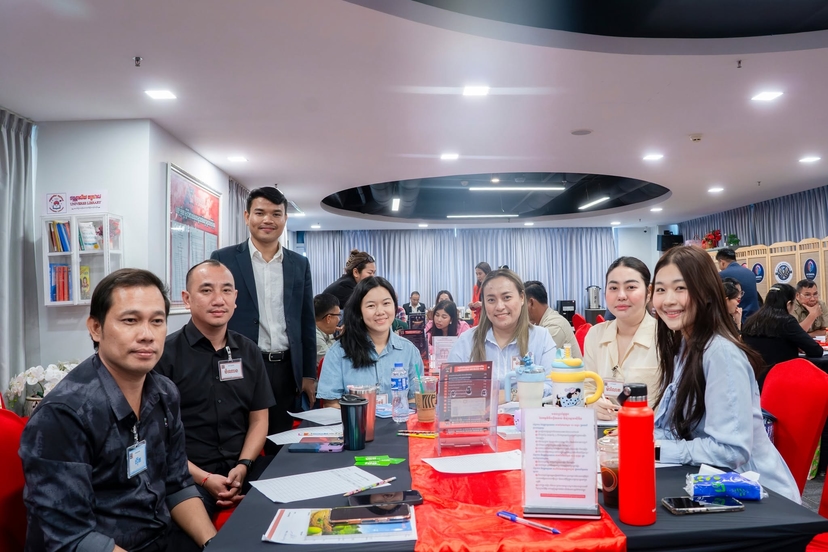
For Ms. IENG Chanthea, owner of CITY Diamond, that realization became the motivation to join the “Accounting Skills for Managing Multiple Businesses” coaching program at CEO Master Club of CEO Institute.

Although her company already uses an accounting system, Ms. Chanthea acknowledged that she had never formally completed university-level studies in accounting. Much of what she knew had been acquired through experience, leaving her feeling that there were still important gaps in her understanding.
That gap became impossible to ignore as her responsibilities expanded.
“When I saw that CEO Master Club offered an accounting course, I became very interested immediately,” she explained. “I told myself that no matter how busy I was, I had to make time to study accounting.”
Her decision reflects a challenge faced by many business owners: entrepreneurs may employ accountants and finance staff, yet still need enough financial knowledge themselves to supervise effectively, ask the right questions, evaluate reports, and make informed business decisions.

A Business Owner Does Not Need to Do Everything—But Must Understand What Is Being Done
For Ms. Chanthea, learning accounting was never primarily about becoming an accountant.
It was about becoming a stronger business leader.
She explained that she had been personally handling much of her company’s accounting-related work and documentation. As the business developed, however, she wanted to transfer more of these responsibilities to qualified employees.
But delegation, she realized, cannot be effective when the leader does not understand the work being delegated.
“I don’t want to do all of the accounting records by myself. I want to use employees,” she said. “But in order to manage employees effectively, I myself need to have clear knowledge. Only when I understand it properly can I guide and manage them well.”
This insight goes far beyond accounting.
A growing company cannot depend forever on its owner personally performing every task. Sustainable growth requires systems, capable employees, accountability, delegation, and leadership.
But delegation without knowledge can create another risk: the owner may lose visibility over what is actually happening inside the business.
For Ms. Chanthea, learning accounting therefore became part of the transition from doing the work herself to managing the people and systems responsible for doing it.

Turning a Difficult Subject Into Practical Understanding
Accounting is often viewed by non-accountants as technical, complicated, and intimidating. Financial statements, transactions, records, costs, profits, cash flow, and other accounting concepts can appear overwhelming—especially to entrepreneurs who never studied the subject formally.
Ms. Chanthea said her experience at CEO Master Club challenged that perception.
She was particularly impressed by the teaching methodology, which she described as significantly different from conventional classroom instruction.
Rather than relying only on textbook-based explanations, she said the trainer used a practical and accessible teaching approach designed to help participants understand accounting concepts even without a previous academic background in the subject.
“The teaching method is really special,” she said. “Other teachers may teach according to lessons and textbooks, but the trainer here uses a different method and technique.”
According to Ms. Chanthea, the approach helped make accounting understandable even for someone entering the program without formal accounting training.
Reflecting on her own learning experience, she added:
“Someone who has never studied accounting before can come and learn. From my experience, after studying for only four days, you can begin to understand it.”
Her statement highlights what she regarded as one of the program’s greatest strengths: translating technical financial knowledge into practical understanding that business owners can apply in real management situations.

Accounting Knowledge Is Leadership Knowledge
For business owners, accounting is not simply about recording transactions.
It can help answer some of the most important questions in business:
Is the company actually profitable?
Where is money being spent?
Which activities generate value—and which quietly consume resources?
Can employees’ financial reports be trusted and understood?
Is the business financially prepared to expand?
Can the owner confidently delegate accounting responsibilities while maintaining effective control?

Without financial understanding, an entrepreneur may own a growing business yet remain uncertain about what the numbers are actually saying.
With greater financial literacy, however, the owner can move from intuition alone toward more disciplined, evidence-based decision-making.
Ms. Chanthea’s experience therefore carries an important message for entrepreneurs: you do not necessarily need to become the accountant of your company, but you should understand accounting well enough to lead the people who manage your company’s finances.

From Working Inside the Business to Leading the Business
One of the most important transitions in entrepreneurship occurs when an owner stops trying to personally carry every responsibility.
In the early stages of a company, the founder may simultaneously handle sales, finance, operations, customer service, purchasing, staffing, and administration.
But that model becomes increasingly difficult as the organization grows.
The next stage requires something different: building people, establishing systems, creating accountability, and developing the knowledge needed to supervise rather than personally execute every task.
For Ms. Chanthea, accounting education is part of that transformation.
Her goal is not simply to learn numbers. It is to develop the confidence and competence to assign financial responsibilities to employees while still maintaining informed oversight of the business.
That is the difference between merely being busy inside a company and developing the capacity to truly manage it.

A Lesson for Business Owners
Ms. Chanthea’s story raises a valuable question for entrepreneurs:
If you employ people to manage your company’s money, how well do you understand the information they give you?
A business owner does not need to master every technical function. But owners who understand the fundamentals of finance and accounting are better positioned to communicate with their teams, monitor performance, detect problems, evaluate opportunities, and make decisions with greater confidence.
For entrepreneurs who have built businesses through experience rather than formal business education, practical training can provide a bridge between what they have learned through years of work and the management systems required for the next stage of growth.
Ms. Chanthea’s decision to study despite a demanding schedule reflects a broader principle of leadership:
Growth in business often begins with growth in the business owner.
When leaders strengthen their own knowledge, they strengthen their ability to develop people, improve systems, delegate responsibilities, and build organizations that can grow beyond their personal capacity.
And sometimes, making time to learn something you have avoided for years may become one of the most valuable investments you make in the future of your company.
Accounting Skills for Business Owners
CEO Master Club of CEO Institute
📍 Venue: CEO Institute, Diamond Twin Tower, Koh Pich, Phnom Penh
🕐 Training Hours: 8:30 AM – 5:30 PM

For business owners seeking to strengthen their financial understanding, improve employee supervision, delegate with greater confidence, and develop stronger management systems, the accounting coaching program at CEO Master Club provides an opportunity to transform financial knowledge into practical leadership capability.
Because you do not have to do everything yourself—but as the owner, you should understand enough to lead everything effectively.